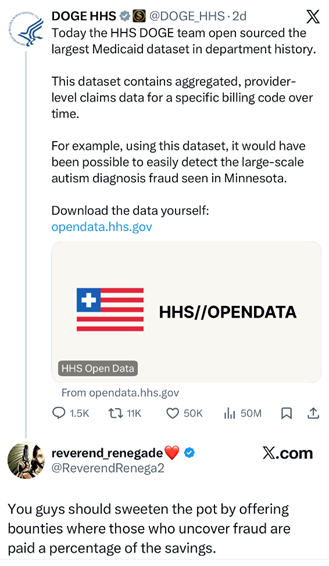
This past Friday, the Department of Government Efficiency (DOGE) unveiled and provided the public access to a sprawling database of Medicaid spending data from HHS. The database contains more claims data and information than has ever been made available to the public in the past and allows users to search for data from specific billing codes and time periods. The release will provide the public with unprecedented opportunities to analyze and identify potential fraud. Indeed, the publication of the database already has created a stir on social media, as pundits, savants and journalists of all stripes begin to dig through the released information.
Right on cue, many have suggested the government should set up some sort of system in which individuals who uncover and report fraud receive a percentage of the savings to the government.
Well, such a system, with all its quirks and imperfections, already exists: the FCA1 and dozens of state law FCA analogues are statutes that authorize private individuals (i.e., whistleblowers or the more highfalutin’, Latin-derived “relators”) to bring claims on behalf of the government against parties who have defrauded the public fisc.
Not surprisingly, DOGE’s announcement has significant implications for litigation under the FCA. On the one hand, the FCA contains a public disclosure bar, which requires courts to dismiss cases when the alleged fraud was publicly disclosed via government reports, hearings, audits, or news media.2 Consequently, while the new Medicaid database may spark a flood of government-derived investigations and subsequent FCA matters, it also has the potential to stifle relator-initiated FCA litigation over Medicaid-based fraud as defendants may be able to point to the database as a prior public disclosure of the alleged fraud.
On the other hand, the FCA specifies that the public disclosure bar does not apply where the relator is an “original source” of the public disclosures. Relators constitute an original source if they can show that they have “knowledge that is independent of and materially adds to the publicly disclosed allegations or transactions.”3 Although standards vary slightly by circuit, a relator “materially adds” to public disclosures when his or her information and contribution is (i) “of such a nature that knowledge of the item would affect a person’s decision-making,” (ii) “significant,” or (iii) “essential.”4 Merely “adding color” to previously disclosed information is insufficient to meet the “materially adds” threshold.
Under that general framework, courts have refrained from applying the public disclosure bar in cases involving alleged fraud previously disclosed in a government database where the relator contributed something uncommon or unique that was not apparent from a standard review of the archived information.5 The determination of the worthiness of a relator’s contribution—i.e., whether it has materially added to a publicly disclosed database—requires a case-by-case analysis.
Further complicating this dynamic is the recent emergence of AI tools with data-processing capabilities far beyond those of individual humans. Indeed, whereas reviewing, analyzing, and identifying trends indicative of fraud from databases containing millions of documents and relevant entries may have taken a team of humans days, weeks, or even months, publicly available artificial intelligence tools can now accomplish the same task in a matter of minutes. Indeed, within hours of the release of the HHS database, most of the prominent data analysts active on public platforms such as X were having a field day putting the available HHS claims information through various AI grinders.6
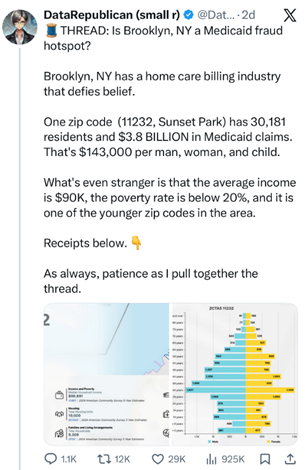
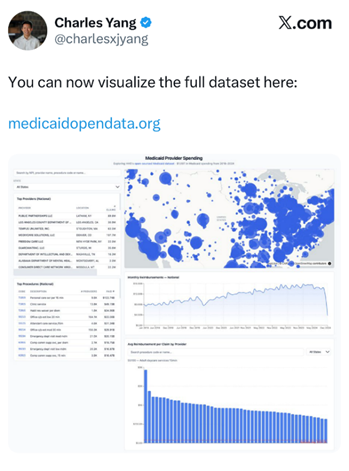
The advent of such prolific data-processing technology coupled with the release of DOGE’s expansive Medicaid database raises the question as to what courts will consider to be “material” additions to preexisting disclosures of public fraud. Will it be enough for enterprising relators to allege that they crafted the unique prompts that enabled AI to identify and uncover fraud that otherwise was not evident or discernable on the face of the publicly disclosed documents? Only time—and the courts—will tell.
Another key question is how DOJ will respond to these developments. Notably, the FCA provides that the public disclosure bar generally applies “unless opposed by the Government.” In other words, DOJ has a unilateral right to veto application of the public disclosure bar in any given FCA case. Insofar as the government desires to incentivize individual relators to bring FCA claims in connection with Medicaid fraud, it may opt to veto use of the public disclosure bar in cases brought based on a fresh analysis, even if AI-aided, of information obtained via the new database. However, to the extent the government does not do so, defendants in such cases will undoubtedly have a much greater arsenal of public disclosures that can be used to pursue dismissal, subject to the courts’ further development of the “materially adds” standard and relators’ novel arguments in this regard.
Ultimately, DOGE’s release of the Medicaid database marks a potentially transformative moment for the treatment of the public disclosure bar in FCA litigation. While the expanded availability of public data may bolster defendants’ ability to invoke the public disclosure bar, the original source exception remains a viable avenue for relators who can demonstrate that their knowledge materially adds to publicly available information. How courts will interpret that standard in an era of AI-powered data analysis—and whether DOJ will exercise its veto authority to encourage whistleblower activity—remain open questions that will shape the contours of this practice area for years to come. Stakeholders on all sides of FCA disputes should closely monitor these developments as the law continues to evolve in response to this new technological and administrative landscape.
- 31 U.S.C. § 3729 et seq ↩︎
- 31 U.S.C. § 3730(e)(4)(A) ↩︎
- 31 U.S.C. § 3730(e)(4)(B) ↩︎
- United States ex rel Coyne v. Amgen, Inc., 229 F. Supp. 3d 159, 172 (E.D.N.Y. 2017) (internal citations omitted) ↩︎
- See, e.g., United States v. Specialist Doctors’ Grp., LLC, No. 817CV2647T24JSS, 2020 WL 7138566, at *4 (M.D. Fla. Dec. 7, 2020) (notwithstanding that alleged fraud was disclosed in CMS database, public disclosure bar did not apply because relator was “in the unique position to know that the services for which Defendant billed Medicare were not performed”); United States v. Kasam, No. 2:22-CV-05198-HDV-JCX, 2025 WL 3724905, at *4-5 (C.D. Cal. Dec. 11, 2025) (holding that public disclosure bar did not apply where relator alleged novel theory of fraud not evident on the face of the public disclosures). ↩︎
- See, e.g., https://www.medicaidopendata.org/ ↩︎